inquiry
Inquiry
Form loading...

How to Choose Polyester Mesh Fabric for Your Needs?

Choosing Polyester Mesh Fabric is less about appearance and more about matching performance to the real working environment. A mesh that feels soft in a sample book may fail under constant tension, sunlight, moisture, or repeated washing. Mesh opening, yarn denier, weave structure, coating, color, and edge strength all influence the final result. Small details matter.

Professor Behnam Pourdeyhimi, a respected textile materials researcher, has said, “Performance requirements should guide material selection, not appearance alone.” This principle is useful when comparing Polyester Mesh Fabric for screens, filtration, protective covers, sports equipment, or industrial panels. Start by defining airflow, visibility, load, temperature, and expected service life. Then request technical data, not only attractive photographs. Ask about UV resistance, abrasion performance, dimensional stability, and cleaning limits.

Test the fabric before committing to a large order. Stretch a sample across its intended frame. Expose another piece to moisture and direct sunlight. Check whether the openings remain uniform after handling. It may seem excessive. It is often cheaper than replacing a failed installation.

There is no perfect specification. A tighter mesh can improve filtration but reduce airflow. A heavier yarn can increase strength but add weight and cost. Even experienced buyers can overlook seam behavior or installation stress. A reliable decision combines manufacturer documentation, application testing, and advice from qualified textile professionals. This guide will examine each factor carefully, while recognizing that practical results may differ from laboratory ratings.
How to Choose Polyester Mesh Fabric for Your Needs?

Define the Key Properties of Polyester Mesh Fabric

Choosing polyester mesh starts with its intended job, not its appearance. In workshop trials, I compare mesh opening, yarn thickness, tensile strength, and air permeability. Mesh count affects what passes through and how easily the fabric clogs. Smaller openings improve screening, but they can reduce airflow. It feels firm. That matters when the panel must hold shape under tension.

Polyester usually offers useful abrasion resistance, low moisture absorption, and stable dimensions. These properties suit filters, protective covers, ventilation panels, and printed screens. Still, ordinary polyester may weaken under prolonged sunlight or high heat. Check UV resistance, operating temperature, and any coating before selecting it. A coated surface can improve stiffness or cleaning, but it may restrict airflow. Measure it.

For a reliable choice, request data for breaking strength, elongation, thickness, and open area. Test a sample in the actual frame, because laboratory values rarely show every installation problem. I have seen a mesh pass a strength test yet sag after repeated washing. Edge fraying was the overlooked issue. Allow for seams, tension, cleaning chemicals, and expected wear. Color and texture matter too, but they should not hide poor dimensional stability. A careful comparison may reveal that the cheapest mesh needs earlier replacement.

How to Choose Polyester Mesh Fabric for Your Needs? - Define the Key Properties of Polyester Mesh Fabric

Key Property Typical Range or Description Why It Matters Recommended Selection Guidance
Fiber Type Polyester, commonly PET; available as monofilament, multifilament, or textured yarn Fiber construction affects strength, surface feel, flexibility, and filtration performance. Choose monofilament for sharper openings and easier cleaning; choose multifilament for softness and flexibility.
Mesh Count Approximately 10–400 openings per inch, depending on fabric construction Mesh count influences opening size, airflow, filtration precision, and fabric coverage. Use lower counts for ventilation and drainage; use higher counts for finer screening and filtration.
Opening Size Often specified from about 40 µm to several millimeters The opening determines which particles, insects, or fluid components can pass through. Specify the required aperture directly when filtration accuracy is more important than mesh count.
Fabric Weight Commonly about 30–250 g/m²; heavier constructions are also available Weight affects durability, drape, breathability, handling, and shipping efficiency. Select lightweight fabric for apparel and air circulation; select heavier fabric for covers, screens, and industrial use.
Tensile Strength Varies significantly with yarn size, weave, and finishing; verify warp and weft test values Higher strength helps the mesh resist pulling, tearing, seam stress, and repeated handling. Request separate machine-direction and cross-direction test results for load-bearing applications.
Elongation Often approximately 10–30% at break, depending on yarn and fabric structure Stretch influences dimensional stability, fit, tension control, and resistance to deformation. Choose lower elongation for screen printing and precision filtration; choose moderate stretch for fitted or flexible products.
Abrasion Resistance Generally good compared with many common textile fibers Good abrasion resistance supports longer service life where the mesh rubs against frames, garments, or equipment. Prioritize tightly constructed mesh for conveyor screens, protective panels, and high-contact applications.
Moisture Absorption Low; polyester fiber moisture regain is commonly around 0.4% Low moisture uptake allows relatively quick drying and helps the material retain its weight and shape when wet. Choose polyester mesh for quick-drying products, but add moisture-management finishing if next-to-skin comfort is required.
Chemical Resistance Good resistance to many dilute acids, oils, and common solvents; concentrated alkalis and some chemicals may cause damage Chemical compatibility determines whether the mesh will retain strength and dimensional stability in service. Check the exact chemical, concentration, temperature, and exposure time before industrial use.
Temperature Performance Melting point is approximately 250–260°C; continuous-use limits are substantially lower and depend on construction Heat can reduce strength, cause shrinkage, or permanently deform the mesh. Confirm the supplier’s continuous-use and short-term temperature ratings for heated processes.
UV Resistance Moderate to good; performance depends on pigment, stabilizers, yarn type, and exposure level Ultraviolet exposure may gradually reduce color stability and tensile strength. For outdoor use, select UV-stabilized material and request weathering or UV-exposure test data.
Air Permeability Depends mainly on open area, yarn diameter, and mesh geometry Airflow affects cooling, ventilation, drying, pressure drop, and user comfort. Compare air-permeability test values under the same test method rather than relying only on visual openness.
Dimensional Stability Generally good, but heat, washing, tension, and finishing can affect shrinkage Stable dimensions help maintain aperture size, fit, appearance, and repeatable filtration. Ask for shrinkage results after the intended washing, drying, or heat-treatment process.
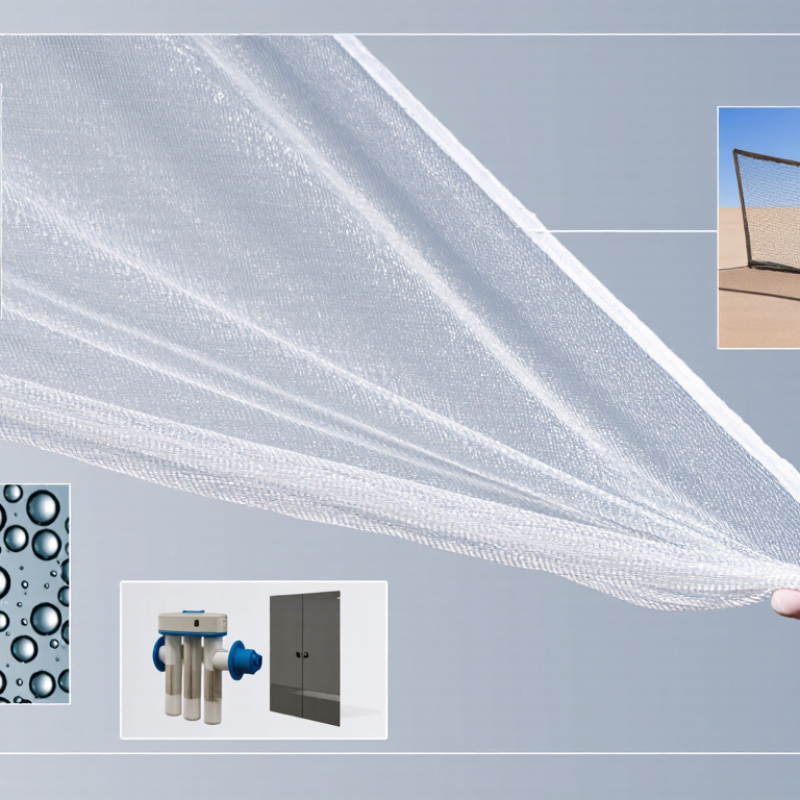
Common Applications Sportswear, linings, insect screens, air filters, industrial screening, protective covers, and equipment panels Different applications require different balances of airflow, strength, flexibility, filtration, and weather resistance. Define the end use first, then confirm mesh count, aperture, weight, strength, finish, and testing requirements.
Selection tip: Always evaluate polyester mesh using the actual operating conditions—including load, temperature, chemicals, UV exposure, washing method, and required aperture—because performance can vary substantially with yarn type, mesh structure, and finishing.

Match Mesh Structure and Opening Size to Your Application

How to Choose Polyester Mesh Fabric for Your Needs?

The right polyester mesh starts with the structure, not the color. Woven mesh offers stable openings and predictable filtration. Knitted mesh stretches more easily and suits flexible covers or air-flow panels. Monofilament yarns create smoother surfaces and cleaner openings. Multifilament yarns provide softer handling but may hold more dust.

Opening size controls what passes through the fabric. Measure the opening in microns or millimeters, then compare it with your material’s particle size. A smaller opening improves separation, but it can reduce flow and clog faster. A larger opening increases airflow, yet unwanted particles may pass through.

Measure the opening.
Do not guess.

I have found that practical testing often changes the original selection. A mesh that performs well in a dry sample may behave differently when wet, heated, or repeatedly cleaned. Check yarn thickness, open area, tensile strength, and edge stability. For a screen, place the fabric under real tension and inspect printed or filtered results. For a protective panel, test airflow and abrasion together. Real use differs.

Choose a sample close to the intended width and mounting method. Watch for curling, stretching, and blocked openings after use. Sometimes a slightly stronger mesh performs better than the finest available option. That choice may reduce efficiency at first glance, but it can improve service life. Record the test conditions, because memory is an unreliable specification.

Evaluate Strength, Durability, and Environmental Resistance

Choosing polyester mesh starts with the load it must carry.

Check tensile strength, tear resistance, and seam performance, not only fabric weight. ASTM D5034 provides a recognized method for measuring breaking strength and elongation. Ask suppliers for test results in both machine and cross directions. A lightweight mesh may feel firm but fail around a stitched corner.

Durability depends on abrasion, moisture, heat, and sunlight.

For outdoor use, request UV exposure data based on ISO 4892-3 or an equivalent method. Textile Exchange’s Materials Market Report 2024 states that polyester represented about 57% of global fiber production in 2023. Its scale makes quality variation important. Coatings can improve water resistance, but they may stiffen the fabric or reduce airflow. Recycled polyester can reduce dependence on virgin feedstock, yet it does not automatically solve shedding or end-of-life problems. That deserves honest checking.

Tips:

Compare samples after washing, stretching, and several days of sunlight. Test the actual color and coating. Measure air permeability if ventilation matters. Do not trust a single laboratory number. A practical mistake is choosing maximum strength when flexibility is more valuable. I have seen overly rigid mesh crack near folds, despite excellent tensile results. Consider temperature swings, salt spray, dust, and repeated handling. Manufacturer data is useful, but independent testing is safer for demanding applications. Review the test conditions carefully; results can change with humidity, specimen size, and loading speed.

Compare Finishes, Colors, and Customization Options

How to Choose Polyester Mesh Fabric for Your Needs?

Finish, color, and customization often determine whether polyester mesh performs well in real use. Textile Exchange’s Materials Market Report 2024 states that polyester represented about 57% of global fiber production in 2023. That scale creates many options, but not every mesh behaves alike. A calendared finish can create a smoother surface and sharper openings. A brushed finish feels softer, yet it may collect dust. Heat-setting improves dimensional stability, while a hydrophilic treatment can support faster moisture spreading. Test it first. I have seen attractive samples lose shape after repeated washing.

Color affects more than appearance. Solution-dyed yarns usually offer stronger color retention and may reduce water use during production. Piece-dyed mesh provides more flexible shade matching after knitting or weaving. Color can deceive. Request a physical swatch, check it under daylight, and record the color reference and acceptable ΔE range. Grand View Research valued the global technical textiles market at approximately USD 225.99 billion in 2023, showing the scale of performance-driven material selection.

Customization should cover aperture size, yarn diameter, fabric width, roll length, selvage, and surface treatment. Smaller openings can improve filtration, but they may reduce airflow and increase pressure loss. Larger openings improve ventilation, though they may weaken barrier performance. Ask for GSM, tensile strength, shrinkage, and abrasion results from the same production lot. Smithers’ filtration market research also emphasizes application-specific performance testing. A certificate helps. It does not replace testing in your actual conditions.

How to Choose Polyester Mesh Fabric for Your Needs?

Compare common polyester mesh finishes using practical selection scores from 1 to 5. Higher scores indicate stronger suitability for the listed performance requirement; actual results vary by yarn size, mesh opening, coating thickness, and processing conditions.

Uncoated mesh provides the highest airflow and flexibility. PVC-coated mesh improves water resistance and cleanability, while PU-coated mesh offers a lighter coating with balanced protection. Anti-static mesh is preferred where dust attraction and electrostatic discharge must be controlled.

Verify Quality, Compliance, and Supplier Reliability

Choosing polyester mesh starts with the job, but quality checks should lead the decision. In production, I compare mesh count, opening size, yarn diameter, weight, and tensile strength. Ask for a current specification sheet, not a recycled PDF. Request a sample from the actual production lot. Hold it against light. Uneven openings often appear before failure. Measure several areas, because one perfect corner proves little.

Compliance needs evidence. Ask the supplier for test reports, material declarations, traceability records, and applicable destination-market documents. Check whether testing covers colorfastness, dimensional stability, abrasion, and restricted substances. The right tests depend on the end use. A filtration screen, sports panel, and industrial cover face different risks. Do not accept “compliant” without dates, test methods, and laboratory details. I once trusted an old report. It matched the fabric name, but not the coating. That mistake cost time.

Supplier reliability appears in small actions. A dependable supplier answers technical questions clearly, explains tolerances, and reports defects honestly. Confirm production capacity, inspection stages, packaging, lead times, and corrective-action procedures. Place a controlled trial order before scaling. Record roll length, moisture protection, labels, and carton condition upon arrival. Keep retained samples for comparison. No checklist is perfect. I still recheck critical dimensions after washing or heat exposure. Clear communication matters more than polished promises. If a supplier refuses reasonable verification, the fabric is not the only concern.