10 Polyester Stretch Fabric Buying Tips for Buyers
Buying Polyester Stretch fabric is not just a matter of choosing a color and checking the price. Buyers need to assess recovery, weight, composition, and consistency across production lots. A swatch may feel smooth on a desk yet become baggy at the knees after repeated wear. Small tests can reveal costly surprises.
Textile scientist Dr. Seshadri Ramkumar is known for his work in textile materials and performance. Rather than attribute an unverified quotation to him, this guide uses a practical buying principle: “Judge stretch fabric by how it performs after movement, washing, and recovery—not by its first touch.” It is a useful reminder, though no single test can predict every garment’s behavior.
The ten tips ahead cover fiber content, stretch direction, fabric weight, recovery, colorfastness, shrinkage, and supplier checks. Ask for the exact blend and test a sample under realistic conditions. Pull it, release it, and inspect how quickly it returns. Wash it. Measure it again. A few wrinkles or uneven edges may not matter for every product, but they deserve attention. Buyers sometimes skip these checks when deadlines are tight. That can be a mistake. Use the checklist as a starting point, then confirm requirements with your product team and supplier before placing a bulk order.
Define the Intended Use and Required Fabric Performance
Before requesting quotations, define where the polyester stretch fabric will be used and what it must do. Leggings need reliable recovery after repeated bending, while a fitted lining may need softness and low bulk. A work uniform may need stronger abrasion resistance and easy care. “Stretch fabric” alone is not a useful specification.
Name the expected conditions. Will the garment be worn in warm weather, washed often, or exposed to backpack straps and seat edges? For activewear, check stretch and recovery in both directions, then assess opacity when the fabric is stretched over a hand or form. For close-fitting garments, confirm that seams do not pucker under tension. Small differences matter. Specify fabric weight, width, composition, and acceptable shade variation. These details make sample comparisons more meaningful.
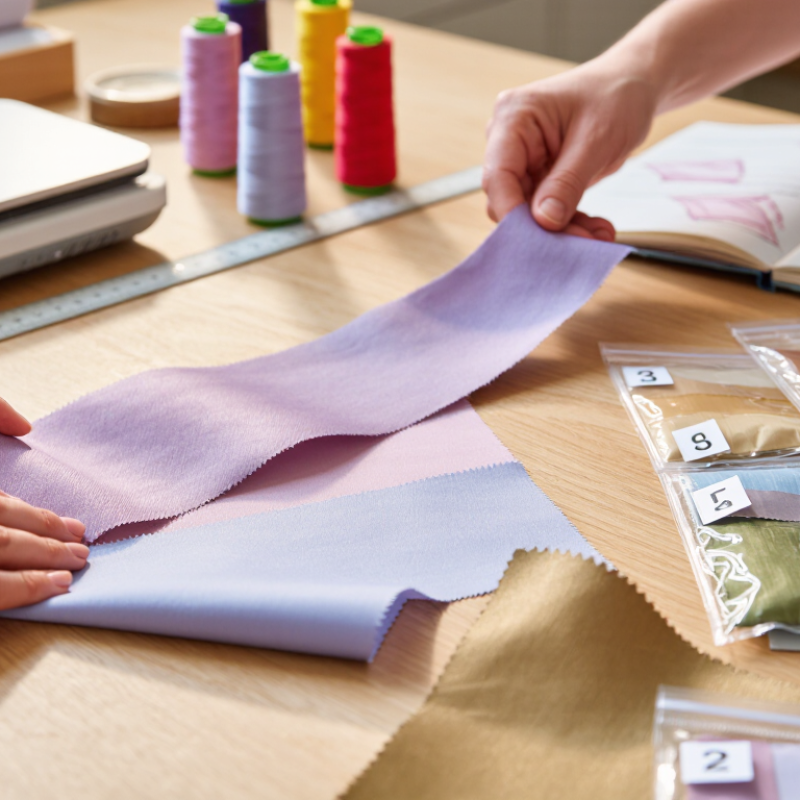
Ask for a physical swatch, not only a specification sheet. Check its feel, thickness, and recovery after several stretches. Then wash it according to the intended care instructions and look for shrinkage, color change, or a rougher surface. One check is never enough. A lab result can guide selection, but it may not reflect the way a finished garment fits or moves. Buyers sometimes focus too much on maximum stretch; dependable recovery and comfort during wear may matter more. If the first sample feels slightly wrong, pause and clarify the use before approving bulk production.
10 Polyester Stretch Fabric Buying Tips for Buyers: Define the Intended Use and Required Fabric Performance
Use these indicative 1–5 priority ratings to compare the performance requirements of different applications. A rating of 5 means the property is especially important; confirm requirements with product specifications and testing.
Priorities vary by end use: activewear often needs stretch recovery and moisture management, while swimwear places greater emphasis on resistance to chlorine and sunlight. Treat these ratings as a buying guide, not laboratory test results.
Examine Fiber Content, Stretch Type, and Recovery
When comparing polyester stretch fabrics, check the full fiber breakdown, not just “polyester stretch.” A fabric with 8% elastane behaves differently from one that relies on crimped polyester yarns for mechanical stretch. Textile Exchange’s Materials Market Report 2024 estimates polyester made up 57% of global fiber production in 2023. That scale makes polyester common, but it does not tell you how a particular fabric will recover. Ask for the blend percentages and whether the stretch runs across the width, length, or both. Small detail. It changes the fit.
Test recovery on a sample before approving bulk fabric. Stretch it to the intended use, release it, then check for bagging at the knee, elbow, or waistband. Repeat the test after laundering; a quick hand pull is not enough. ASTM D3107 covers stretch properties of woven fabrics made with stretch yarns, while ASTM D2594 addresses low-power stretch in knitted fabrics. Ask suppliers or an independent lab which method suits the construction. Request the test conditions and results, not only a “good recovery” claim. I still treat one neat swatch with caution: fabric behavior can shift across a roll, and a single sample may not reveal it.
Evaluate Fabric Weight, Construction, and Surface Finish
When comparing polyester stretch fabric, check its weight in grams per square metre, but do not treat GSM as a quality score. A 220 GSM fabric may feel supportive, while a lighter option may suit a lining. Ask for the test method and usable width. Small differences matter.
Look closely at construction. Knits often allow easier movement, while wovens may feel more stable, depending on their structure and elastane content. Stretch a swatch across and along its grain, then release it. Does it recover, or stay wavy? Check the seams too: a smooth sample can still curl or skip stitches when sewn. Give it a wash. Then inspect again.
Surface finish affects both appearance and use. A brushed face may feel soft but show pilling sooner; a glossy finish can reveal scratches under strong light. Rub the fabric with a clean, dry cloth, and view it near a window. Simple checks help. They are not lab tests. Request samples from the intended production lot when possible, since finishing can alter the hand feel. Compare swatches after folding them overnight; crease marks may affect cutting and display. I would not choose from a photograph alone, though even a sample may not represent every roll.
Test Durability, Colorfastness, and Dimensional Stability
When assessing polyester stretch fabric, request results from the same lot you plan to buy, not a showroom swatch. Textile Exchange’s 2024 Materials Market Report puts polyester at 57% of global fiber production in 2023. That scale makes reliable quality checks especially important, but it does not guarantee consistent performance.
Ask for AATCC TM61 wash and TM8 crocking tests; check both color-change and staining grades. A grade 4 target can work as a buyer specification, but it is not a universal pass requirement. Inspect wet and dry rubbing. For durability, test stretch and recovery after repeated extension, then assess abrasion under expected use. Small swatches can mislead.
For dimensional stability, use AATCC TM135 or ISO 5077 after a stated wash-and-dry cycle. Record length and width changes separately, and set a tolerance, such as ±3%, before sampling. Repeat testing on bulk fabric. A neat lab report can still miss variation between rolls, so ask for the lot number, wash temperature, drying method, cycle count, and conditioning details.
Compare Supplier Quality, Pricing, Certifications, and Terms
Polyester stretch fabric can appear identical on a screen, yet behave very differently on a cutting table. Compare samples for weight, width, surface feel, and stretch recovery. Pull the fabric across and along the grain, then check whether it returns to shape. Wash a swatch and note any twisting, pilling, or color change. Small details matter. Ask whether the sample matches the production lot, not just the supplier’s best piece.
Compare prices on the same basis. A low price may exclude sampling, special finishing, packing, or freight. Check the minimum order quantity and ask how overage or defects are handled. I still find it easy to focus on the price per yard and miss the cost of unusable fabric. Not always obvious. Request written specifications for composition, weight, width, and acceptable tolerances.
Review certificates carefully: confirm the document covers the material or process you are buying, and check its date and scope. A certificate alone does not prove every shipment will match your sample. Ask for current test reports where relevant. Compare payment terms, production lead time, inspection arrangements, and the process for reporting quality issues. Put agreed details in writing. Even then, small shade differences can happen, so clarify how much variation you can accept before placing a large order.